
When considering relocating, “cost of living” is often treated as a vague feeling rather than a hard metric. But moving is a financial transaction. You are trading one set of economic variables for another.
In Michigan, the macro data points to a highly efficient environment, with overall costs sitting roughly 5% to 10% below the national average. However, that discount isn’t applied evenly across the board. To truly understand how far your salary will go, we have to break down the specific components—from housing savings to the hidden costs of your daily commute.
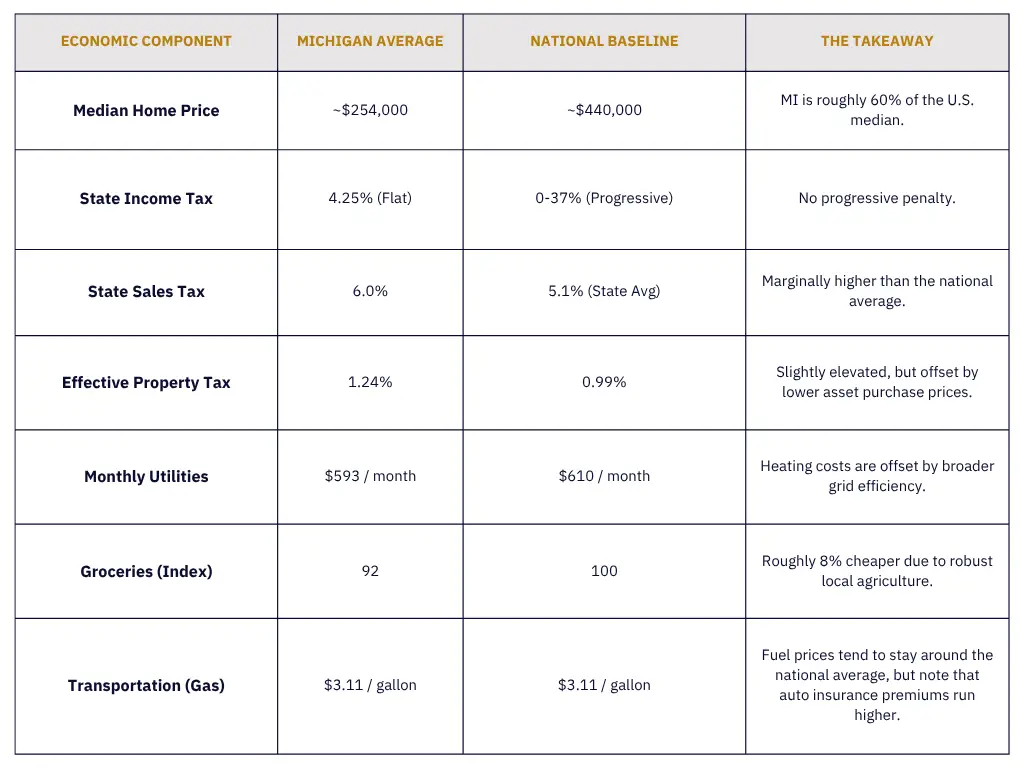
Here is the data-driven breakdown of what it actually costs to live in Michigan:
Housing and Taxes
These are the two variables that have the biggest impact on your wallet.
- Housing: This is where Michigan offers the highest leverage. The statewide median home price is roughly $254,000, sitting at just 60% of the national average ($440,000). But remember, averages obscure the local reality. You may be able to buy into the Detroit metro for under $200,000, while other suburban neighborhoods primarily exhibit million dollar homes. Alternatively, you might enter the booming Grand Rapids market around $280K, or pay a premium in the Ann Arbor tech corridor at $425K. Across the board, housing and rent run about 13% below the U.S. baseline, but can vary significantly from one neighborhood to another.
- Income Tax: Michigan operates on a flat 4.25% state income tax. There are no progressive tax brackets to penalize higher earners, and most municipalities (with a few exceptions, like Detroit’s 2.4% local tax) do not levy local income taxes. Furthermore, Michigan has zero estate or inheritance tax, simplifying long-term wealth transfer.
Property Tax: The effective property tax rate is 1.24%, which is slightly higher than the 0.99% national average. However, the state offers a generous Homestead Property Tax Credit (up to $1,900) that can significantly offset this liability for eligible primary residences.
Operating Expenses
Once the house is bought and the taxes are paid, what does it cost to simply run your household?
- Utilities & Groceries: Heating a home through a Michigan winter might sound expensive, but statewide utility bills (electric, gas, water) average $593 a month, coming in slightly below the national average of $610. Because of local agriculture, your grocery bill will also run about 8% cheaper than the rest of the country. Healthcare costs remain generally on par with the national baseline.
- Auto Insurance: Here is the friction point. While gas prices hover right at the national average, Michigan consistently ranks among the most expensive states for auto insurance. This is largely driven by the state’s unique no-fault insurance laws. When modeling your monthly budget, you must account for this premium increase.
What This Means for Your Relocation Strategy
- The High-Income Advantage: If you are a high earner moving from a state with progressive income brackets (like California or New York), Michigan’s flat 4.25% rate combined with a 40% discount on median housing creates a massive opportunity to accelerate your wealth building.
- Audit Your Transit Costs: The savings in housing, utilities, and groceries will almost certainly outweigh the higher auto insurance premiums, but you still need to run the math on your specific vehicles so there are no surprises.
- Location Considerations: Median home prices vary greatly from neighborhood to neighborhood. You can optimize your housing costs by carefully selecting which specific township or city aligns with your commute tolerance, budget, and lifestyle preferences.
Comments