
How State, County, City, Township, and Village Taxes Affect Your Homeownership
Property taxes in Michigan are not imposed by a single governing body. They are the result of multiple jurisdictional layers operating simultaneously, each with a distinct role. Understanding how these layers interact requires separating regulatory authority from operational authority.
The System Architect (State)
At the highest level, the State of Michigan sets the ground rules for taxes. The state does not directly determine the full rate a homeowner pays–it establishes the structural rules under which all local taxation must operate.
The state defines:
- Constitutional millage limits
- The methodology for determining assessed value
- The growth cap on taxable value (inflation or 5%, whichever is lower)
- Oversight and compliance standards
Think of the state as drawing the borders of the playing field. It sets the rules but doesn’t run the daily local services funded by property taxes. The state regulates the system, but it only makes up a small portion of the total millage rate on a homeowner’s bill.
The Regional Framework (County)
Every property in Michigan sits within a county, making this a universal layer on your tax bill. The county bridges the gap between state rules and local neighborhood services.
Counties levy millage to fund regional needs, including:
- Law enforcement (Sheriff’s Office) and the courts
- Public health and human services
- Regional road commissions
- Tax equalization and administration
The county handles the big-picture services that are simply too large for a single town to manage efficiently. You will pay a county tax regardless of whether you live in a city, township, or village.
The All-in-One Hub (City)
In Michigan, cities and townships are mutually exclusive. If your property is located inside an incorporated city, you do not pay township or village taxes. The city absorbs those responsibilities completely.
Cities levy a single, consolidated millage to fund services such as:
- Full-time public safety (police and fire)
- Exclusive public works (water, sewer, and waste management)
- Local road maintenance and lighting
- Civic administration and zoning
While city taxes are often higher than township and village taxes, they include a more comprehensive package of services including advanced parks and recreation, sidewalks, consistent street lighting, centralized water and sewer treatment, etc. I currently pay $35 a month for trash in a township, $420 annually. When I lived in Livonia, the city taxes were much higher, but I never had to worry about how to dispose of trash. I remodeled the entire house without a dumpster and they picked up everything I put on the curb from toilets to contractor bags.
The Local Level (Township)
For many residents, the township is where property taxation hits closest to home.
Townships levy millage to fund direct local services such as:
- Fire protection
- Administrative services
- Local infrastructure
- Public works
- In some cases, law enforcement
Unlike the state, which defines rules, the township directly implements the homeowner’s total millage rate. Township millage is applied on top of county and school district rates. This means that two properties in the same county can experience different tax burdens if they sit in different townships.
An Additional Overlay (Village)
A village is an incorporated municipality that may exist within a township. When a property is located inside a village, another fiscal layer may be added.
Villages may levy their own millage to fund:
- Local police services
- Municipal utilities
- Streets and sidewalks
- Community-specific infrastructure
To summarize, property taxes create a stacked structure. Each layer operates independently but compounds into a single effective rate. The homeowner does not pay these layers separately. They appear as one combined tax bill, even though they originate from different authorities. All millage rates, none of which are hierarchical in payment order, from these jurisdictions are summed and applied to the taxable value of the property.
Total Property Tax in a Township:
Taxable Value × (State + County + Township + Village + School District Millages)
Total Property Tax in a City:
Taxable Value × (State + County + City + School District Millages)

Where Further Variability Emerges
The state layer is structurally stable because it operates through caps and standardized formulas. Variability emerges at the city, township, and village levels. These jurisdictions:
- Vote on millage increases
- Approve bond measures
- Adjust funding needs based on local priorities
As a result, two neighboring properties in different municipalities may experience different effective tax rates, even if their market values are identical. The homeowner’s experience is therefore highly localized, even though the framework is statewide. Understanding this layered interaction is essential before evaluating whether a given property tax burden is “high” or “low.” The headline number alone does not reveal which layer is driving the outcome.
Quantitative Distribution: County-Level Evidence
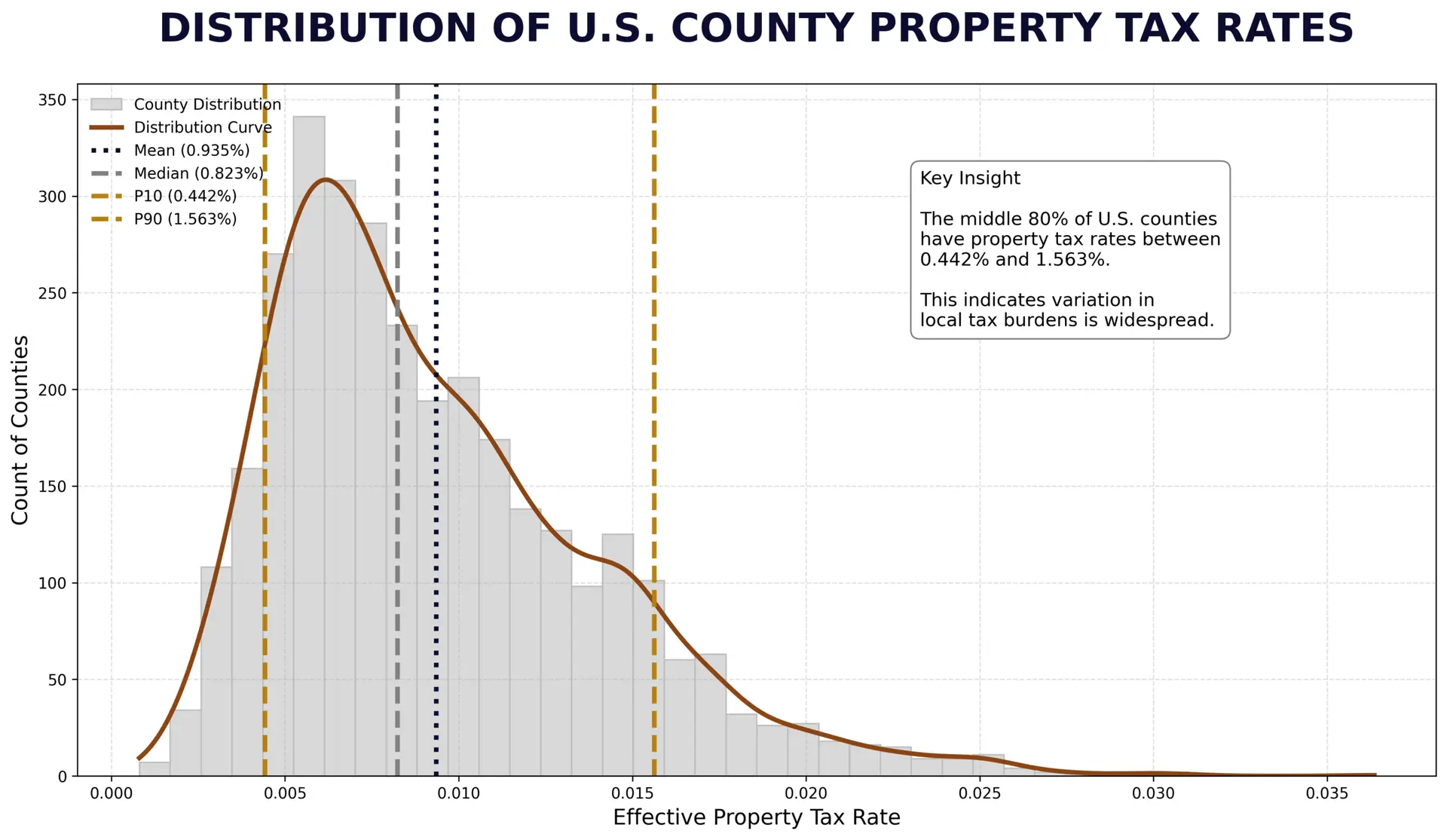
Knowing how property taxes stack is just the first step; looking at the actual data shows just how extensively those rates differ from one community to the next. Based on 2023 county-level data, the vast majority of counties (the middle 80%) saw effective tax rates that varied significantly—from 0.442% to 1.563%.
These fractions of a percent might look small on paper, but they hit your wallet directly. For example, on a $300,000 home, moving from 0.442% to 1.563%, more than triples your annual tax bill from $1,326 to $4,689. That’s a massive difference that you want to be sure you are getting value for.
Michigan County-Level Variability
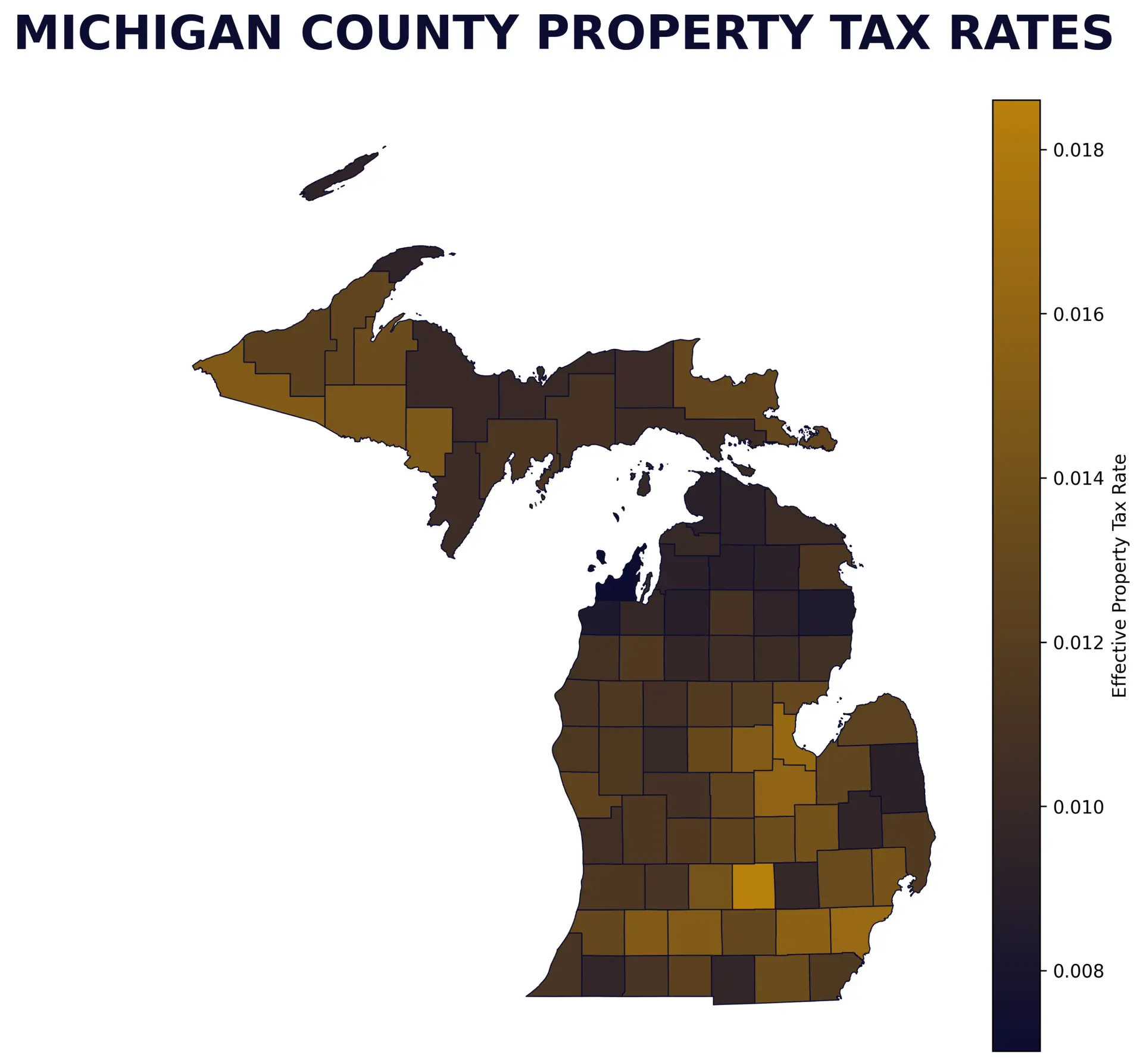
Within Michigan alone, effective property tax rates range from 0.702% to 1.860%. This implies that the highest-rate county levies approximately 2.65 times the rate of the lowest-rate county.
The total spread within Michigan is 1.158 percentage points. Even within a single state operating under the same constitutional constraints, local layering produces substantial divergence.
The P10–P90 range confirms that this dispersion is not driven solely by extreme outliers. Variability is systemic rather than incidental.
From a modeling standpoint, this indicates that municipal selection can materially alter long-
term carrying costs, independent of statewide averages.

Special Assessments: What They Cover and Why They Exist
Special assessments are often misunderstood because they do not behave like standard millage rates. Unlike state, county, township, or school district millage, which are ongoing and broadly applied, special assessments are project-specific financial overlays applied to particular properties. Special assessments are typically used to finance localized infrastructure improvements that directly benefit a defined group of properties.
Common examples include:
- Road paving or resurfacing
- Sewer line installation or upgrades
- Water main extensions
- Sidewalk construction
- Street lighting improvements
- Drainage or flood control projects
From a systems perspective, special assessments exist to solve a fairness problem. If a township needs to install a sewer line serving only one neighborhood, it would be inefficient, and politically unwise, to raise millage for the entire township to fund a localized improvement.
How Special Assessments are Structured
Unlike millage rates, which are typically expressed as a rate per $1,000 of taxable value (mills), special assessments may be
structured as:
- A fixed dollar amount per property area
- A cost per frontage foot
- A cost per parcel
- A temporary millage increase for a defined term
They may be:
- One-time charges
- Multi-year installments
- Bond-backed obligations repaid over time
Therefore, special assessments represent one of the highest localized risk drivers in the property tax
system. Unlike state-imposed caps on taxable value growth, special assessments are not
constrained by inflation caps.
Are You Average?
While technically accurate, statewide averages obscure structural dispersion. The difference between counties is not marginal; it can represent thousands of dollars annually when applied to typical home values. Property taxation, like interest rates in affordability modeling, must be evaluated as a distributional system. If you aren’t “average,” why fixate on the average headline?
Apply local tax data to your specific situation here: https://thefppartners.com/free-analysis-toolkit
Comments