
Engineering True Yield and Scaling Beyond the Retail Hype
The mainstream media loves to sell real estate as the ultimate “passive income” hack. The narrative is incredibly enticing: borrow as much money as the bank will legally give you, buy a property, and let the rent checks roll in while you sip coffee on a Tuesday morning.
It sounds fantastic in the short reality TV show clips, but treating a highly dynamic physical asset like a simple dividend stock is a dangerous game that needs to be played strategically.
Let’s be clear: real estate is arguably one of the most powerful wealth-creation vehicles in existence. But true “passive” income is not a default setting; it is an engineered outcome. When you strip away the media hype, you realize that building a resilient portfolio requires treating your assets like a micro-business. Amateurs get wiped out by the friction; professionals model the friction and use it to scale safely.
Setting the Board: Additional Variables to Consider
In Media to Models 8, we broke down the fundamentals of real estate investing. To build a portfolio that outlasts market cycles, you have to abandon the retail mindset and evaluate the transaction through the lens of First Principles modeling. In addition to what was discussed last week, we track specific interactions between a set of primary variables to optimize your strategy:
- Purchasing Power (P(c)): Your Financial Horsepower. The total amount of cash and safe debt you can deploy.
- Time Bandwidth (T(b)): Your Personal Time and Energy. The physical hours you have available in a week.
- Operational Expenses (OpEx): The Cost of Doing Business. The ongoing bills required to keep the property running—crucially, this includes the money you spend to hire professionals so you can buy back your personal time.
- Liquidity (L(q)): Your Cash Safety Net. The emergency funds set aside to absorb expensive surprises without sinking the investment.
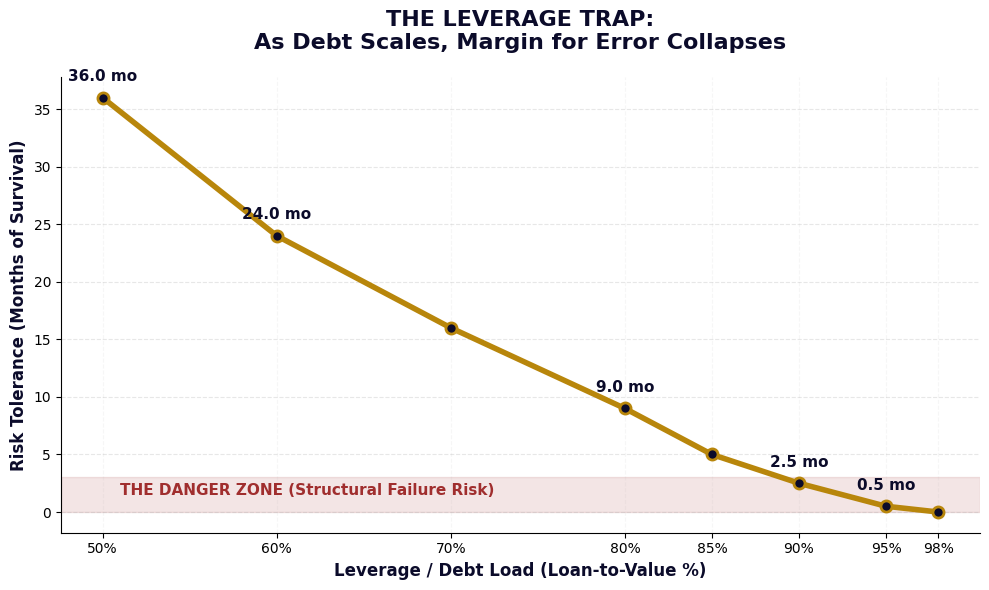
- Risk Tolerance (R(t)): Your Financial Breaking Point. Exactly how many empty units or missed payments the property can survive before you are forced to pay the mortgage out of your own pocket.

Lever 1: Calibrating the Double-Edged Sword of Debt
The mainstream narrative tells you to use “Other People’s Money” to acquire the biggest asset possible. But here is the objective mathematical reality: Pushing your debt to the limit maximizes your immediate buying power, but it strips away critical buffers, leaving you with dangerously narrow margins for error when the market shifts.
Imagine a new investor who maxes out their debt-to-income ratio to buy a property that only cash flows $200 a month. They feel like a real estate mogul. But by maximizing their leverage, they have artificially compressed their Risk Tolerance (R(t)). If the property sits vacant for just 30 days between leases, it will take them months to recover the lost revenue.
A First Principles investor doesn’t fear debt. They intentionally limit their leverage to ensure a massive cash-flow buffer and Liquidity (L(q)). They willingly trade maximum theoretical scale for absolute structural resilience. When the market softens, the over-leveraged amateur is forced to sell at a loss. The mathematically sound investor easily absorbs the shock and looks for their next acquisition.
Lever 2: Escaping the “Sweat Equity” Ceiling
The media also assumes that managing a property is free. It isn’t. You are paying for it—either with your capital or with your personal time.
Early in an investor’s journey, it is tempting to “optimize” returns by doing the work yourself. Imagine having plans to spend a sunny Saturday morning with your family after a week of gloomy weather–then you get the dreaded text: a tenant’s garbage disposal is backing up. Instead of enjoying your weekend, you find yourself spending three hours under a sink. You might have saved a $150 plumber’s fee, but you didn’t generate a massive real estate yield—you simply hired yourself as a maintenance worker for your tenants.
Buying back your personal time means hiring professionals, which converts your physical labor into a fixed Operational Expense. New investors can view property management fees as a loss of profit. Professional investors view them as the required cost to scale. You cannot underwrite and acquire your third, fourth, or fifth property if your Time Bandwidth (T(b)) is consumed by fixing toilets.
The Reality Check: Engineering Asset Yield (Y(a))
This brings us to the ultimate optimization metric: Asset Yield (Y(a)).
As discussed in Part I, Asset Yield is the true bottom line. It is the actual profit your property produces after all operational friction, CapEx reserves, and the value of your own time are subtracted.
Let’s run the model on a $400,000 property renting for $3,000 a month, with a $2,600 mortgage (PITI).
New investors might calculate their yield using a naive “Gross Rent minus Mortgage” equation. $3,000 rent minus the $2,600 mortgage leaves $400 a month. They project a $4,800 annual return and celebrate.
The First Principles investor runs the true Asset Yield equation. They know the property does not exist in a vacuum. From that $3,000 in gross rent, they immediately subtract an 8% property management fee ($240), an 8% vacancy assumption ($240), and a 10% Capital Expenditure and maintenance reserve ($300).
Suddenly, that $3,000 gross revenue is reduced by $780 of operational friction before the mortgage is even paid.
$3,000 (Rent) – $780 (Friction) – $2,600 (PITI) = -$380 / month.

The amateur investor thought they bought a cash-flowing asset; the math proves they actually bought a liability that is bleeding $4,560 a year–and they might not even realize it until the roof leaks or the tenant moves out. Professionals engineer their deals by quantifying margins of safety over these baseline operational costs. They build their models to absorb the inevitable shocks because they know exactly how these variables cross-react. By planning for all expenses, professional investors are able to strategically account for all expenses–allowing them to turn a profit all while staying out from under the sink.
Are You Average?
The headlines want you to believe that real estate investing is a foolproof, effortless path to wealth. The reality is that it is a complex, deeply rewarding system of trade-offs between your capital, your risk limits, and your personal time. Debt management and yield generation must be evaluated on a rigorous, individual basis. Master the system, and the wealth follows. If you aren’t “average,” why fixate on the average headline?
Apply this methodology to your specific situation here:
Comments