
The Physics of Cash Flow — Deconstructing True Rental Yield
The mainstream media loves to summarize real estate investing with a dangerously simple equation: Rent minus Mortgage equals Profit. They paint a picture where buying an investment property simply involves collecting a check on the first of the month, paying the bank, and pocketing the difference. It is an incredibly enticing narrative that fuels the “passive income” hype.
But a house is not a dividend stock. A house is a physical structure exposed to weather, wear-and-tear, and the unpredictable nature of human behavior. It is subject to the laws of entropy—it is constantly degrading, and it costs money just to exist.
If you model an investment using the media’s oversimplified equation, you aren’t actually calculating yield; you are simply ignoring the physical reality of the asset. To build a resilient portfolio, you have to strip the transaction down to its First Principles and model the true friction of the property.
The Two Buckets of Friction: OpEx vs. CapEx
Before you can calculate what a property actually yields, you have to separate its expenses into two distinct categories. Blurring these lines is the number one reason new investors run out of liquidity.
- Operational Expenses (OpEx): The Cost of Doing Business
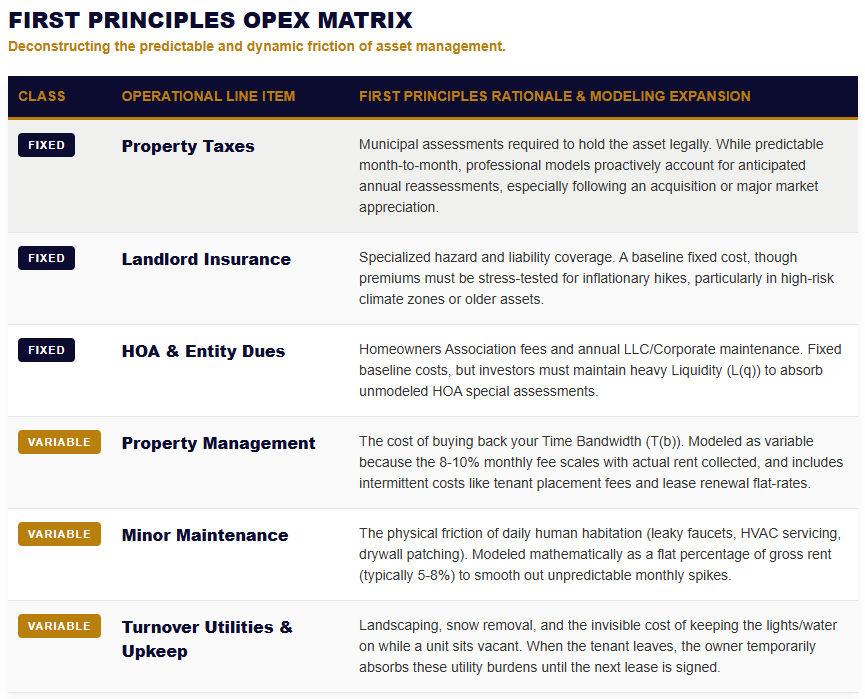
OpEx consists of the routine, predictable costs required to keep the asset functioning on a day-to-day basis. These are the line items that chip away at your monthly gross rent:
- Fixed OpEx: Property taxes, landlord insurance premiums, and HOA dues (if applicable).
- Variable OpEx: Minor maintenance (e.g. fixing a leaky faucet, patching drywall), landscaping, and property management fees.
- Capital Expenditures (CapEx): The Cost of Time
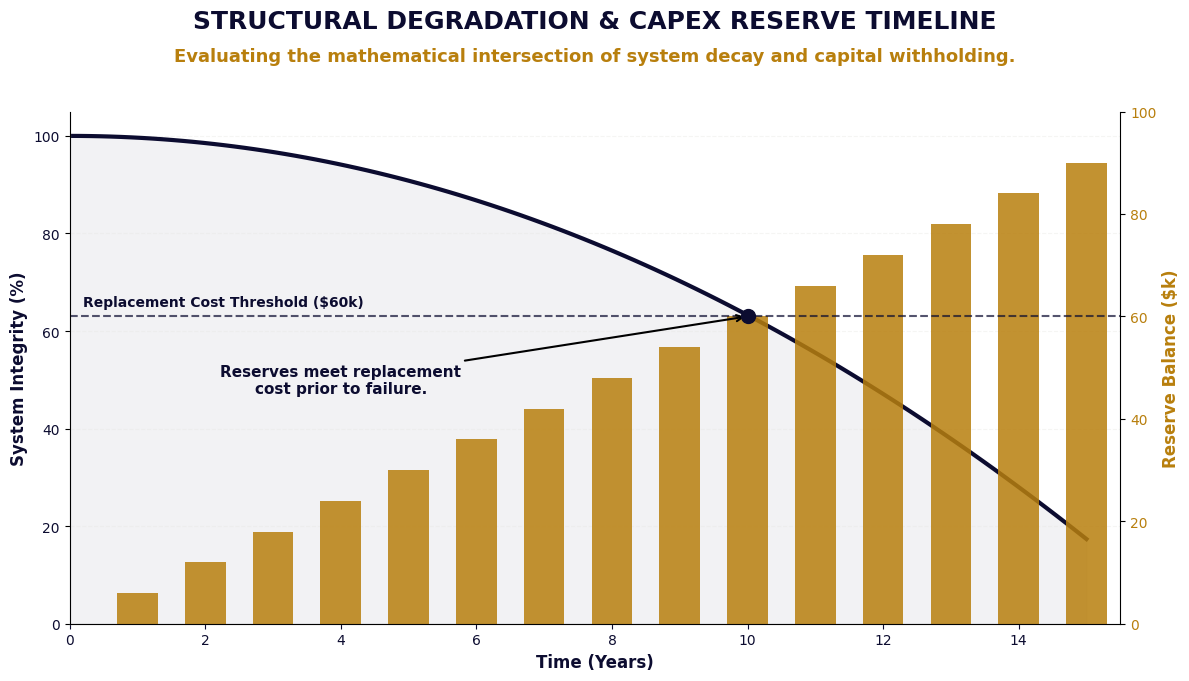
CapEx represents the large, systemic replacements that reset the lifespan of the asset. This includes a new roof, replacing an HVAC system, or rebuilding a foundation.
Conventional thinkers view CapEx as a surprise emergency. First Principles investors view CapEx as a mathematical certainty. You do not pay for a new roof all at once in Year 15; that roof is physically deteriorating by a specific dollar amount every single month. Rigorous models calculate the lifespan of every major system in the house and withhold a percentage of the monthly rent to fund a CapEx Reserve account. If you are spending your CapEx reserves as “profit,” you are slowly bankrupting your future self.
The Invisible Thief: Vacancy & Turnover
The second fatal flaw in conventional modeling is assuming a property will remain 100% occupied, 365 days a year, for a decade.
In reality, tenants move out. When they do, the physical friction of turnover begins. You must paint, clean, repair, and market the unit. During this time, the property generates exactly zero revenue, but your mortgage, taxes, and insurance bills remain due.
In a rigorous financial model, vacancy is treated as a hard monthly expense. By withholding a baseline Vacancy Reserve (typically 5% to 8% of gross rent), you structurally engineer a safety net so that an empty unit is a calculated event, not a financial crisis.
The Mathematical Reality: Engineering True Yield
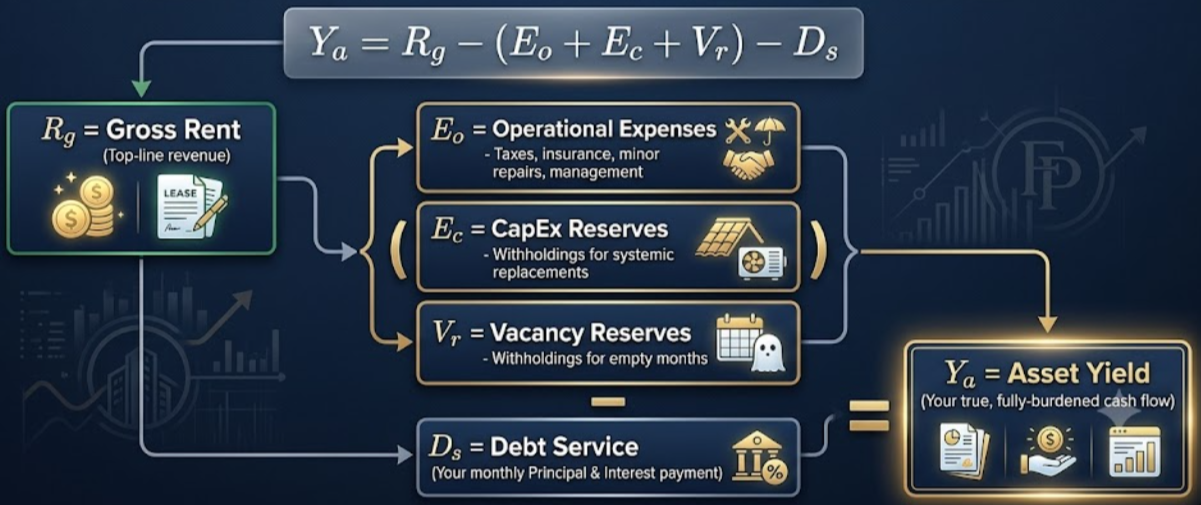
When we strip away the hype and account for the physical reality of the asset, we arrive at the actual formula for cash flow. To calculate your true Asset Yield, you must utilize the full operational equation:
Let’s run the numbers on a real-world example: A $350,000 single-family rental.
You secure a tenant paying $2,800 a month. Your total monthly mortgage payment (including taxes and insurance) is $1,800.
The amateur investor runs the media’s naive equation: $2,800 in rent minus the $1,800 payment equals a phenomenal $1,000 a month in profit. They scale their lifestyle and celebrate their new passive income.
The First Principles investor runs the true Asset Yield equation. They separate the Principal & Interest ($1,400) from the Taxes & Insurance ($400) and account for the remaining physical friction of the property:
- Gross Rent: $2,800
- OpEx: $850 (Taxes, Insurance, Property Management, Minor Repairs)
- CapEx Reserve: $224 (8% of rent withheld for future roofs/HVAC)
- Vacancy Reserve: $140 (5% of rent withheld for turnover)
- Debt Service: $1,400 (Principal & Interest)
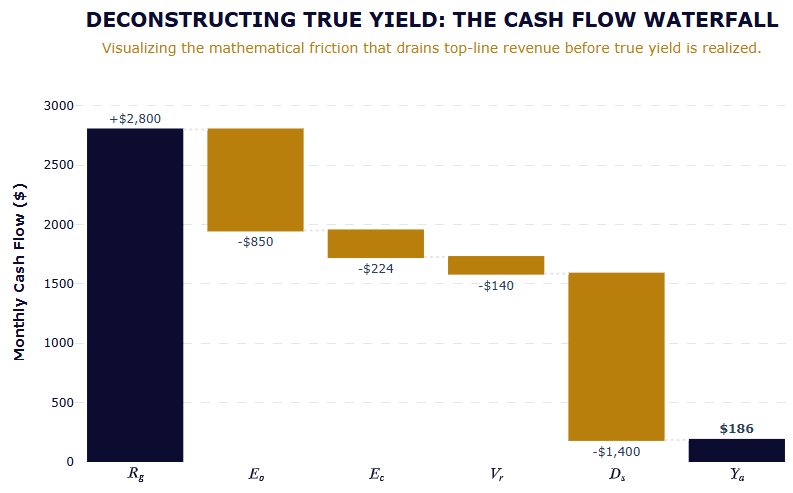
$2,800 (Rent) – $1,214 (Total Friction) – $1,400 (Debt) = $186 / month.
The amateur thinks they are making $1,000 a month. The professional knows they are actually yielding $186 a month. The amateur will be financially wiped out by their first major plumbing failure; the professional has already funded the repair through their reserves without missing a beat.
Are You Average?
The media portrays purchasing an investment property as a foolproof, effortless path to wealth, focusing entirely on top-line revenue while neglecting the mathematical realities of what it actually takes to maintain a physical structure. Real estate is one of the most powerful wealth-creation vehicles on the planet, but true yield is not a default setting—it is an engineered outcome. Your investments must be treated with a full, transparent look at the data. If you aren’t “average,” why fixate on the average headline?
Comments